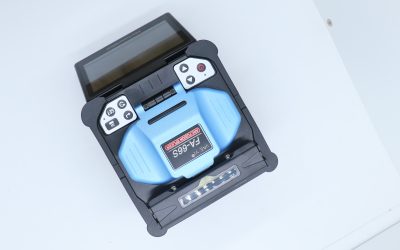
Fiber splicing is the process of joining two optical fiber ends together so light passes through with minimal loss. If you’re running a fiber cable from a street cabinet to someone’s living room, at some point you need to connect two fibers end-to-end. That connection point is a splice. And how well you make that splice determines whether your network runs clean or drops signal.
Nanjing Vaeyi Technology Co., Ltd. has been building fiber splicing tools for over a decade, so let’s break this down the way we’d explain it to a new technician on site.
What Does Fiber Splicing Actually Do?
A single optical fiber is about 125 micrometers across — thinner than a human hair. The glass core inside, where the light actually travels, is 9 micrometers for single-mode fiber. That’s about 1/8th the diameter of a hair.
When you cut a fiber, the ends are never perfectly flat. Even a tiny gap or angle between two fiber ends causes light to scatter, which means signal loss. A splice fixes this by bringing two prepared fiber ends into direct contact and either fusing them together with heat (fusion splicing) or holding them in alignment with a mechanical fixture (mechanical splicing).
The goal is always the same: make the connection behave as if the cable was never cut.
Fusion Splicing vs Mechanical Splicing: What’s the Difference?
These are the two main methods, and they work quite differently.
Fusion splicing uses an electric arc to literally melt the two fiber ends together. A fusion splicer aligns the fibers, fires the arc, and the glass fuses into a single continuous piece. Typical splice loss for single-mode fiber is around 0.02 to 0.03 dB. That’s low enough that most network designs treat it as negligible.
Mechanical splicing uses a small alignment sleeve or V-groove to hold the two fiber ends in contact. An index-matching gel fills any microscopic gap. No heat, no melting. It’s faster to set up and requires less equipment, but the loss is typically 0.1 to 0.5 dB per splice — higher than fusion.
So which one should you use? Here’s a quick comparison:
| Factor | Fusion Splicing | Mechanical Splicing |
|---|---|---|
| Typical loss | 0.02–0.03 dB | 0.1–0.5 dB |
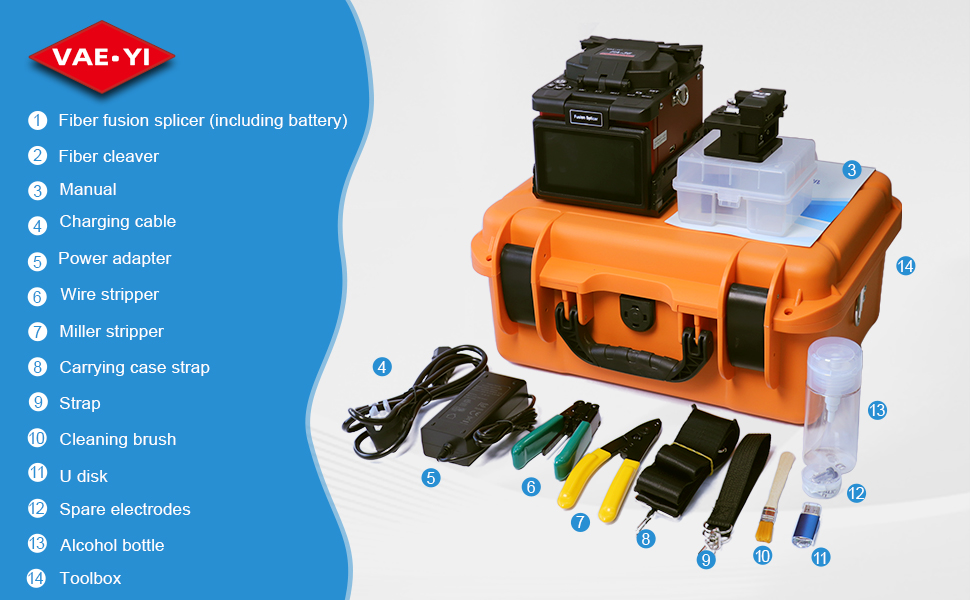
| Equipment needed | Fusion splicer + cleaver + stripper | Mechanical splice kit + cleaver |
| Cost per splice | Low (electrodes last thousands of splices) | Higher (each sleeve is single-use) |
| Best for | Long-haul, FTTH, data centers, permanent links | Emergency repairs, temporary connections, low-budget jobs |
| Long-term stability | Excellent — glass is fused | Good, but gel can degrade over years |
For most telecom and FTTH installations, fusion splicing is the standard. The equipment costs more upfront, but per-splice cost is lower and the results are more reliable over decades.
The 5 Basic Steps of Fiber Splicing
Whether you’re using a VAEYI FA-36 or a FA-66S core alignment splicer, the process is basically the same:
- Strip — Remove the coating (250μm) down to bare glass (125μm) using a fiber stripper. Mechanical strippers like the VAEYI FSP-3 handle standard fibers; thermal strippers like the FSP-200PRO work better for specialty fibers with tough coatings.
- Clean — Wipe the bare fiber with alcohol-soaked lint-free wipes. This step matters more than people think. A single dust particle on the fiber end can turn a 0.02 dB splice into a 0.3 dB mess.
- Cleave — Score and break the fiber to create a flat end face. A good cleaver gives you an angle under 0.5 degrees. The VAEYI P12 one-step cleaver, for example, averages ≤0.5° across 48,000 uses per blade position.
- Splice — Place the fibers in the splicer. The machine aligns them (either by cladding or by core), fires the arc, and estimates the loss. On a VAEYI FA-66S six-motor splicer, this takes about 6 seconds in fast mode.
- Protect — Slide a heat-shrink sleeve over the splice and shrink it in the splicer’s built-in heater. This protects the bare glass from bending and moisture.
The whole process takes about 30 to 60 seconds per splice once you’re set up. An experienced tech can do 100+ splices in a day.
Where Fiber Splicing Is Used
Fiber splicing shows up in three main scenarios:
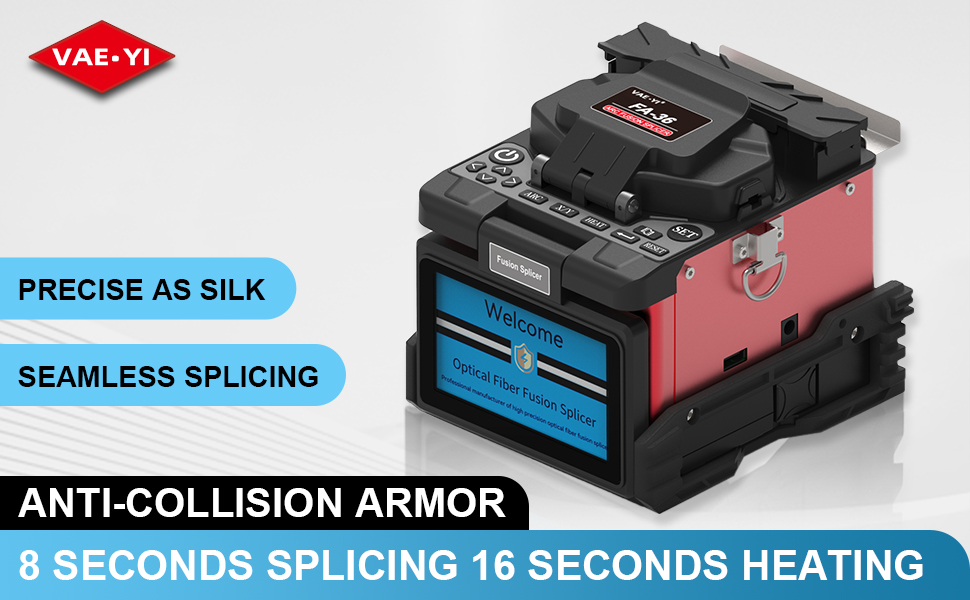
- FTTH (Fiber to the Home) — Connecting the drop cable from the street to the customer’s optical network terminal. This is high-volume, repetitive work where speed matters. A 4-motor splicer like the FA-36, with its 8-second splice time and 5200mAh battery good for about 250 splices per charge, fits this workflow.
- Data centers — Running fiber between server racks and patch panels. Here, consistency matters more than speed because downtime is expensive. Core alignment splicers like the FA-66S give you 0.02 dB loss on single-mode fiber, which keeps your link budget healthy.
- Long-haul networks — Joining multi-kilometer cable sections. These splices need to last 25+ years underground or on poles, so fusion is the only option. Loss budgets are tight, and every 0.01 dB counts over hundreds of kilometers.
Common Mistakes to Avoid
We’ve seen the same problems show up again and again:
Dirty fibers. Skipping or rushing the cleaning step is the #1 cause of bad splices. Clean the fiber, then cleave it — not the other way around.
Dull cleaver blades. A cleaver blade that’s past its life gives angled or chipped ends. If your splicer keeps reporting “excessive angle” or “cleave failed,” check the blade position first.
Wrong splicer for the job. Using a cladding-alignment splicer on a tight-loss budget link will give you headaches. Core alignment costs more, but it actually lines up the 9μm cores — not just the 125μm cladding. That means lower loss and fewer re-splices.
The Bottom Line
Fiber splicing is about making two glass strands act as one. Fusion splicing gives you the lowest loss and the best long-term reliability, while mechanical splicing works for quick fixes and tight budgets. The tools matter — a good cleaver, a clean workflow, and the right splicer for your application make the difference between a 0.02 dB splice and a 0.3 dB splice.
Want to know which VAEYI splicer fits your workflow? Send us a message — we usually reply within a few hours.